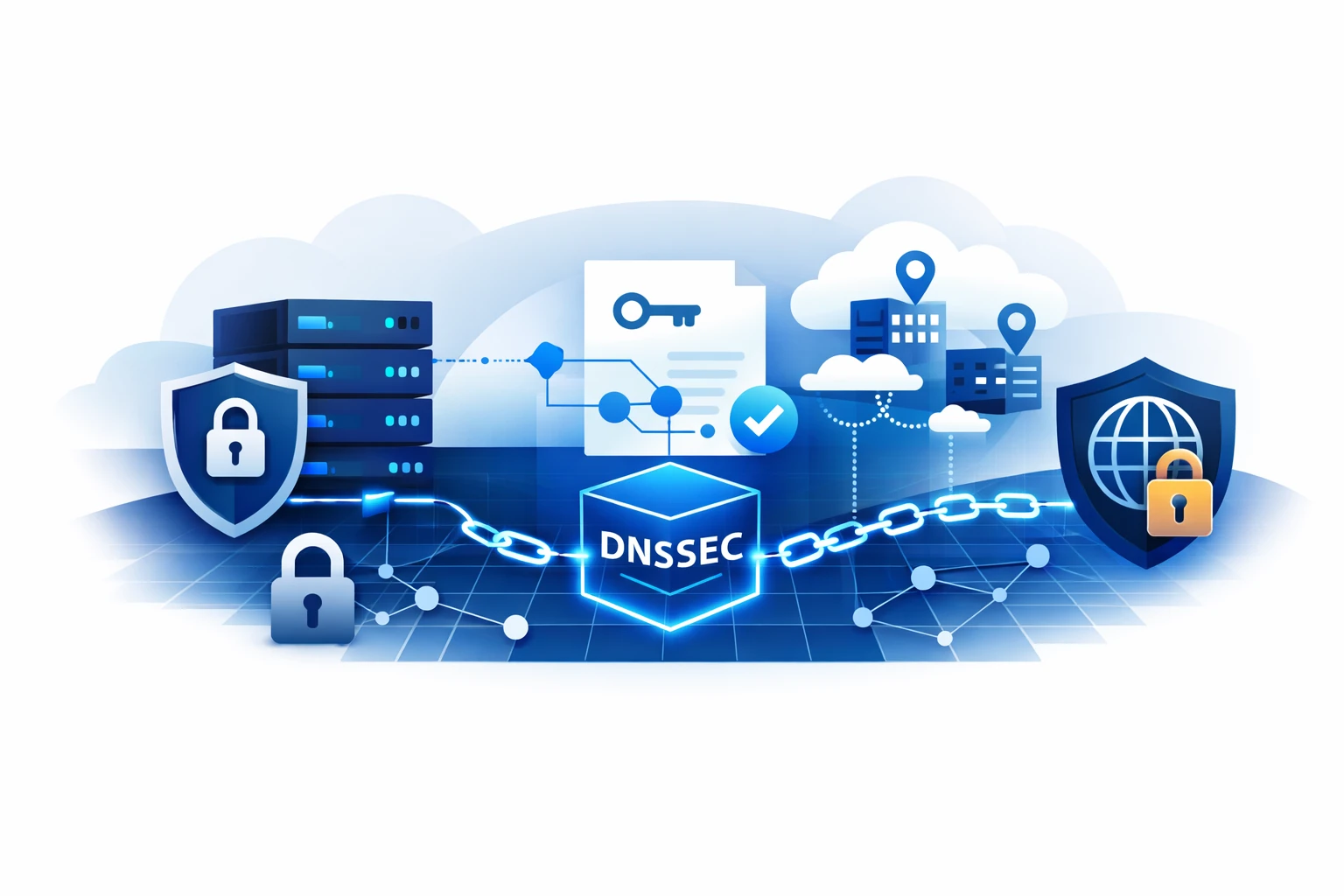
DS Publication Orchestration for SaaS DNSSEC Readiness: A Practical Onboarding Blueprint
Across multi-tenant SaaS platforms, a recurring but often underestimated challenge is enabling DNSSEC for customer domains in a scalable, low-risk way. The typical pattern—customers bring their own domains and expect a seamless onboarding—requires more than turning on a feature flag. It demands disciplined DS publication in parent zones, robust key management, and continuous validation across a distributed registrar landscape. When DS records are not published correctly or when signing decisions lag, customers encounter validation failures that manifest as SERVFAIL responses, outages, or degraded user trust. This is not merely a technical nicety: it is a governance and operational challenge that sits at the intersection of security, reliability, and customer success.
DNSSEC builds a chain of trust from the root down through each delegated zone. Central to that chain are DNSKEY records (the zone’s public keys) and DS records (delegation signers) stored in the parent zone. The DS record acts as the validated fingerprint that links a child zone’s cryptographic keys to the parent, enabling resolvers to validate responses as authentic. In practice, successful DS publication across the hierarchy reduces risk of spoofed answers and accelerates trust in domains under management. Cloudflare’s explanation of the DNSSEC mechanics and DS linkage offers a concise conceptual anchor for teams new to the topic, while DNSimple’s glossary clarifies the role of DS in the chain of trust. (cloudflare.com)
The SaaS-ready DS publication lifecycle
To scale DNSSEC for customer domains, you should treat DS publication as a defined lifecycle with clear ownership, not as a one-off event. The lifecycle typically includes: inventorying domains, deciding signing scope, signing zones, publishing DS records in parent zones, configuring key rotation, and implementing ongoing validation monitoring. ICANN and other authoritative sources emphasize that a functioning DNSSEC ecosystem requires both signing and validation to be operational along the entire chain from root to individual domains. As of 2020, ICANN notes that all generic top-level domains (gTLDs) are signed and that validating resolvers should enable DNSSEC validation to reap the benefits of the chain of trust. The practical takeaway for SaaS operators is to design the onboarding process so each step is automated, auditable, and aligned with customer SLAs. (icann.org)
Step-by-step onboarding framework for SaaS platforms
The following six-step framework is designed for a multi-tenant environment where customer domains may be added gradually or in bulk. Each step should be codified in an automation pipeline to minimize human error and to provide traceable evidence for compliance reviews.
- 1) Inventory and scope — Compile a live inventory of customer domains, the authoritative name servers, registrar details, and any existing DS/DNSSEC configurations. A centralized ledger supports governance reporting and risk assessment.
- 2) Signing strategy — Decide which zones to sign (customer zones, a shared SaaS zone, or both), and determine signing keys, algorithms, and rotation cadence. A minimalist approach starts with customers who explicitly opt in to DNSSEC and expands progressively.
- 3) DNS signing and RRSIG management — Sign zones with DNSKEYs and publish the corresponding RRSIGs. Ensure that signing keys are protected in hardware security modules (HSMs) or equivalent secure key stores and that access controls are properly enforced.
- 4) DS publication in parent zones — Publish DS records in the parent zone(s) that govern the child zones. This step is the critical link in the chain of trust. Coordinate with registrars or registries to minimize propagation delays and avoid stale trust anchors.
- 5) Key rollover and algorithm transitions — Plan and test key rollover scenarios, including warnings to customers and rollback procedures. Document fallback plans in case a DS mismatch occurs after rollover.
- 6) Validation monitoring and incident response — Implement a continuous validation dashboard (see the framework below) and define escalation paths for validation failures, misconfigurations, or registrar delays.
Automation is essential. DS publication, key management, and monitoring should be integrated into your CI/CD pipelines and change-management practices so that every customer domain change passes through the same governance gates. If you need concrete tooling patterns, a production-ready blueprint often includes a combination of zone signing automation, registrar API integrations, and centralized dashboards that surface DS status, signing certs, and validation results in near real time. The goal is to make DNSSEC readiness a repeatable, pass/fail decision rather than a hand-crafted, one-off implementation. For references on DS concepts and their role in the chain of trust, consult DNSSEC primers and the DS/DNSKEY explanations provided by Cloudflare and DNSimple. (cloudflare.com)
Architecture patterns and practical patterns for automation
In a SaaS context, you can adopt several architecture patterns that balance speed, security, and governance. The following strategies are common among mature deployments:
- Centralized signing with per-customer delegation — The SaaS platform maintains a signing service for shared zones and issues DNSKEYs for customer zones, with DS records published in the parent zones by an automation layer. This reduces operational burden while preserving customer autonomy over their own DNSSEC configuration.
- Registrar-aware automation — Implement registrar APIs to push DS records automatically or use registrar-managed DS publication workflows. This approach minimizes propagation delays and portfolio-wide misconfigurations.
- Automated rollover tooling — Use scripted key-generation, rollover windows, and DS fingerprint checks to ensure that validators continue to see the correct chain of trust during transitions.
- Telemetry-driven validation — A health dashboard that aggregates DS status, DNSKEY validity, and validator responses from representative resolvers provides operators with early visibility into issues before customers notice outages.
From a customer-experience perspective, the DS publication process should be invisible unless problems arise. If your automation is robust, a customer onboarding flow can be completed with minimal manual intervention, while the governance team maintains auditable evidence of DS publication and key management. For readers who want a reference point, ICANN’s resources and the DNSSEC learning materials from Cloudflare provide foundational context for these patterns. (icann.org)
A practical framework: the four-quadrant DS readiness model
To help teams assess readiness at a glance, you can use a lightweight four-quadrant model that maps DS publication status against registrar readiness and customer opt-in. The four quadrants are:
- Quadrant A — Signing + DS Published with registrar support and customer opt-in. This is ideal for production onboarding and ongoing validation.
- Quadrant B — Signing but DS Pending — You have a signed zone but DS is not yet published in the parent zone. Treat as a staging state; resolve DS publication promptly to restore end-to-end validation.
- Quadrant C — DS Published but Signing Pending — A rare state that indicates reciprocal issues; you should re-evaluate signing configuration or policy.
- Quadrant D — Neither Signing nor DS Published — This is a risk posture to avoid for any customer domain. Initiate immediate onboarding workflows and governance checks.
This model makes it easier for operations to identify where a domain sits in the readiness spectrum and to implement targeted actions. For teams that want more nuance, extend the model with a second axis representing validation status (validating, failing, unknown) to capture real-time resolver feedback. The objective is to keep the model lightweight while enabling precise action plans. For broader context, consult industry primers on DNSSEC architectures and the role of DS records in the chain of trust. (cloudflare.com)
Implementation plan: a 90-day runbook sample
To operationalize the onboarding blueprint, consider a phased runbook that segments work into weeks. The plan below is illustrative and should be tailored to your organization’s size, technical maturity, and customer portfolio.
Inventory, stakeholder alignment, and signing policy definition. Establish ownership, data retention policies for DNSSEC-related artifacts, and a plan for customer communications. Pilot signing and DS publication with a small subset of customers who opt in. Implement registrar integrations and begin real-time validation logging. Expand pilot, automate key management workflows, and tune DS propagation timing by coordinating with registries. Introduce a customer self-service onboarding checklist for domains that opt into DNSSEC. Full portfolio rollout, mature monitoring dashboards, and incident response playbooks. Document lessons learned and update governance policies.
Two practical notes: (1) Even when automation is strong, you should maintain a human-in-the-loop review for new registrars or TLDs with nonstandard DS publication workflows; (2) communicate clearly with customers about timelines for DS publication, propagation, and potential validation windows. ICANN’s DNSSEC FAQs and deployment guides provide useful, up-to-date context for governance and deployment milestones across diverse TLDs. (icann.org)
Expert insight and common limitations
Expert insight: A seasoned DNS operations leader emphasizes that the biggest success factor in SaaS DNSSEC onboarding is automation that enforces a reproducible, auditable process. He notes that automation reduces the risk of human error during DS publication and key rotations, which are the two most error-prone areas in multi-tenant environments. At the same time, he cautions that an architecture that signs domains but never publishes DS records in the parent zone is effectively non-functional for end-user validation, and this gap can be difficult to detect without active monitoring.
Limitations and common mistakes to watch for include: (a) assuming DS publication happens automatically at scale without registrar cooperation, (b) overlooking registrar-specific propagation delays that can leave customers in a transitional “unsafe” state for longer than expected, (c) failing to align trust anchors when algorithm upgrades occur, and (d) neglecting customer communication that leads to misaligned expectations. A practical defense is to implement a unified validation dashboard, cross-check DS fingerprints against parent zones, and maintain a documented rollback plan for any rollover. ICANN and Cloudflare resources discuss these dynamics and provide practical guidance to avoid these pitfalls. (cloudflare.com)
Risks, limitations, and common mistakes in SaaS DNSSEC onboarding
Despite best efforts, some limitations persist in large-scale, multi-tenant deployments. The most prevalent issues include:
- Registrar/API fragmentation — Not all registrars expose DS publishing via APIs; some require manual steps or partner onboarding, which can slow time to full validation.
- Propagation latency — DS fingerprint propagation across parent zones can vary, creating validation windows where some resolvers see a valid chain and others do not.
- Key rollover coordination — Rollover events can momentarily disrupt validation if DS records are not updated in lockstep with DNSKEY changes.
- Customer domain privacy considerations — While DNSSEC protects authenticity, it does not inherently obfuscate data; additional privacy controls may be desirable in certain deployments.
- Partial adoption risk — If only a subset of customers adopts DNSSEC, the overall platform can appear brittle; plan for phased adoption with customer communications and SLAs.
These realities underscore why a governance-first, automation-enabled onboarding approach is essential. The industry’s best practice is to pair DS publication with continuous validation and incident response readiness. For teams seeking deeper operational guidance, Oracle’s DNSSEC troubleshooting guide and DNSimple’s glossary offer practical checks and definitions to avoid common misconfigurations. (docs.oracle.com)
Expert insight: a practical note on customer onboarding and governance
One industry expert highlights that the governance layer—the documentation, change-control, and customer communications—often determines success or failure when onboarding a large set of customer domains. He suggests treating DNSSEC readiness as a product feature with explicit SLAs, not a purely technical toggle. The expert also cautions that some customers may not understand DNSSEC implications; transparent guidance and a clear contact path for support are essential for trust and adoption. (icann.org)
Limitations and a final caveat for practitioners
Even with a robust onboarding framework, DNSSEC deployment faces real-world constraints. A notable limitation is the variability among registrars in DS publication workflows, including API support, documentation quality, and propagation timelines. Operators should avoid over-optimistic assumptions about universal registrar automation and instead implement a staged rollout with explicit customer notifications. The industry consensus, as reflected in ICANN and vendor-focused guidance, remains that DNSSEC is a deployable and valuable security layer, but it requires disciplined operational practices and ongoing validation. (icann.org)
Conclusion: making DNSSEC readiness a repeatable capability
For SaaS providers hosting customer domains, the value of DNSSEC lies not in a one-time sign-off but in the repeatable governance pattern that ensures continuous trust. By aligning an onboarding framework with automation, registrar-aware DS publication, and real-time validation monitoring, you create a scalable, auditable, and customer-centric DNSSEC program. This approach minimizes outages, accelerates time-to-protection for new customers, and supports governance responsibilities that modern service providers must uphold. For businesses that want a turnkey solution to DS publication orchestration across portfolios, partner options exist that can help automate DS publication, ensure consistent trust anchors, and provide ongoing validation insights—an area where dnssec.me’s ecosystem and partner networks can offer practical, production-grade guidance. You can explore WebAtla’s domain portfolio solutions to see how DS publication orchestration can be implemented at scale in a SaaS context: WebAtla’s DS publication orchestration service. Additional domain portfolio resources, including lists by TLDs, can be found here: List of domains by TLDs. For a deeper understanding of the broader DNSSEC landscape and ongoing standards discussions, ICANN’s deployment materials and Cloudflare’s DNSSEC explanations are valuable references.