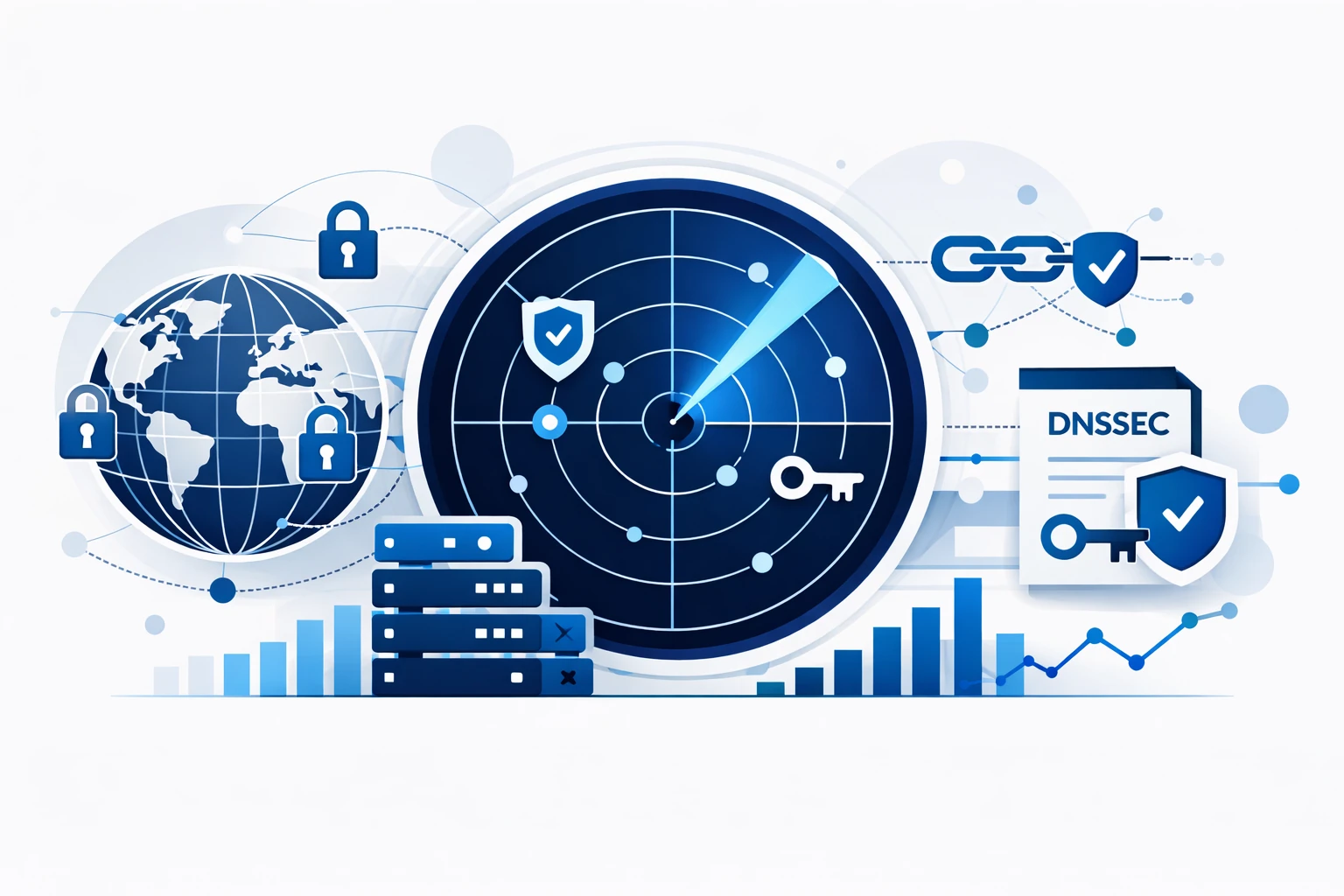
Introduction: A focused, practical path through the DNSSEC maze
DNSSEC is a powerful layer of defense for domain resolution, but its real-world deployment rarely looks like a polished, textbook example. For small businesses and multi-domain portfolios, the challenge isn’t just “enable DNSSEC” — it’s implementing a durable, manageable DS lifecycle that survives registrar quirks, registry policies, and varying resolver behavior across networks. This article offers a pragmatic, issue-aware framework — the DS Lifecycle Radar — to help you plan, implement, and monitor DNSSEC in a way that fits lean teams and tight budgets while preserving the benefits of cryptographic authenticity and data integrity in every signed zone.
Rather than a broad, one-size-fits-all overview, this guide hones in on a specific, high-value niche: how to manage the DS lifecycle across a small but growing portfolio, with attention to key management, DS publication workflows, validation readiness, and ongoing monitoring. The guidance draws on foundational DNSSEC standards and best practices from IETF RFCs and leading policy bodies, then translates them into actionable steps you can apply to a handful of domains or dozens of zones with confidence. For teams that need concrete steps and credible references, this approach reduces ambiguity while keeping the door open to automation as your portfolio scales.
The DS Lifecycle Radar: a 5-step, decision-driven workflow
To operationalize DNSSEC without overbuilding, treat the DS lifecycle as a radar with five interconnected axes: inventory, key strategy, DS publication, validation readiness, and monitoring. Each axis informs the next, and a missed step in one area often triggers cascading issues in others. Below, we walk through each step with practical actions, common pitfalls, and expert considerations drawn from core DNSSEC standards.
Step 1 — Inventory and classify your domains
The lifecycle begins with a precise inventory. A realistic view of your portfolio helps determine which zones require signing now, which registries support DS publication, and how quickly you need to scale. An inventory should cover at least:
- Domain count and zone types (single-domain, subdomains, and any IDN variants)
- Registry and registrar capabilities (DS publication support, CDS/CDNSKEY options, DS TTL controls)
- Current signing status (signed vs unsigned, RRSIG presence, DNSKEY counts)
- TTL and cache behavior expectations for DS data
Actionable tip: map your domains to the relevant TLDs and registrars. If you need a reference inventory tool, WebAtla publishes domain datasets by TLDs that can help you quickly identify which registries you’ll need to interact with as you scale. See WebAtla’s list of domains by TLDs for context when planning DS publication across registries.
Expert insight: in practice, the most impactful gains come from a clean inventory and a commitment to keep it synchronized with registrar and registry changes. Even a light-touch inventory reduces “unknown zone” risk when a DS update is required.
Step 2 — Define a Key Strategy (KSK vs. ZSK) and rotation cadence
DNSSEC relies on key signing keys (KSKs) and zone signing keys (ZSKs). A pragmatic approach for small portfolios is to separate responsibilities and set predictable rotation cadences that balance security with operational stability. Key considerations include:
- Which keys sign the DNSKEY RRSet (KSK) and which sign zone data (ZSK)
- Rotation cadence that aligns with your risk tolerance and registrar capabilities
- Backup and storage policies for private keys (HSM or secure software keystorage, with restricted access)
- Procedure for detecting and recovering from signing failures or key compromises
In DNSSEC practice, a measured cadence helps avoid “key rollover fatigue” where frequent changes create gaps in trust. RFCs describe the roles of DS, DNSKEY, and related signatures that underpin the trust chain, and provide a standard vocabulary for these operations. For a technical grounding, see RFC 4034 (DNSSEC Resource Records) and RFC 4035 (Protocol Modifications), which define the DS and DNSKEY interplay and the broader protocol implications.
Expert insight: a balanced approach to key management recognizes that overly aggressive rollover can create validation gaps, while too-slow rotations extend exposure time to potential key compromise. A predictable schedule supported by automation reduces risk and stress.
Step 3 — Establish a DS publication workflow with registries
Publishing DS records (or CDS/CDNSKEY equivalents where supported) is the heart of the trust chain between parent and child zones. The steps typically include:
- Publish the DNSKEY in the signed zone and publish the corresponding DS digest in the parent zone
- Coordinate with registrars/registry operators to ensure DS records reflect in the parent zone’s delegation data
- Decide on DS TTLs that balance cache efficiency with timely updates during rotations
- Document the workflow and ensure it’s repeatable for all domains in your portfolio
Important nuance: some registries support CDS/CDNSKEY automation, which can speed DS publication and rotation, while others require manual DS publication through registrar UI. When automation isn’t available, plan for interim validation pauses and clear rollback steps. The RFCs governing DNSSEC (RFC 4034 for DS and DNSKEY records; RFC 4035 for protocol changes) provide the formal definitions that underlie these workflows. ICANN’s deployment guidance also highlights the practicalities of publishing DS data across registries.
External reference: for a concise, standards-based overview of DS publication and the trust chain, see RFC 4034 and RFC 4033.
Client note: if you’re cataloging a portfolio’s exposure across registries, WebAtla’s domain lists by TLD can help identify the registries you’ll interact with during DS publication and updates.
Step 4 — Validate readiness: testing DNSSEC across the resolver ecosystem
Validation is not optional once you publish DS records. You should verify that resolvers can build the chain of trust from the root, through the TLD, to the zone, and that signed responses validate as expected. Practical validation steps include:
- Query the zone for DNSKEY and DS records and look for RRSIG signatures and a positive AD/OK outcome on validating resolvers
- Test failover scenarios, such as intentionally removing DS data to observe resolver behavior (to confirm fallback behavior is as expected)
- Watch for clock skew issues, which can cause signature validity windows to appear invalid; ensure NTP time synchronization across DNS signing and validation systems
RFCs provide the canonical behavior for validation processes and the role of the DS chain in authenticating answers. For practical validation guidance, RFC 4033 (DNS Security Introduction and Requirements) and RFC 4034 (DNSSEC Resource Records) are foundational references. In addition, DNS validation can be affected by clock synchronization; NICs and organizations note time drift as a common source of validation failures, so ensuring accurate system time is a standard, essential check.
Expert insight: validation is as much about process maturity as about cryptographic strength. Even with perfect keys, misconfigurations or timing issues can create false negatives. A disciplined validation protocol reduces that risk.
Step 5 — Monitoring, telemetry, and ongoing health checks
DNSSEC health is dynamic. Domains can drift out of sync, registries can evolve their policy, and resolver operators may alter their validation behavior. Implement a lightweight telemetry and health-check plan that covers:
- Active checks for DS/DNSKEY consistency across domain delegations
- Monitoring for DS TTL drift and missing DS records in parent zones
- Alerting on validation failures from external resolvers (where visibility is possible) and internal resolvers
- Regular audits of key rotation and DS publication timing against the agreed cadence
In practice, many teams start with a simple, monthly health check and evolve toward an automation-first approach as their portfolio grows. The literature on DNSSEC health and telemetry emphasizes that observability is a security control in its own right — a deliberate stance that complements cryptographic strength with operational discipline. For technical grounding on how DNSSEC signatures are generated and validated, RFC 4034 and RFC 4035 are the primary references; ICANN’s deployment guidance also underscores the importance of ongoing health checks.
Common pitfalls and limitations: what can derail your DS lifecycle?
Even with a solid plan, several missteps are especially common in small portfolios. Recognize and prepare for these to keep validation intact and the trust chain intact over time.
- Missing DS publication in the parent zone: The DS record is what anchors the chain of trust for a zone. Without DS in the parent, signed data appears invalid to validating resolvers, and users see insecure or failing responses. This is a fundamental deployment error, often caused by registrar or registry workflow gaps rather than a miscalculation of the digest itself.
- Digest mismatch or digest type confusion: The DS digest must correspond to the child zone’s DNSKEY; digest type (SHA-1, SHA-256, etc.) must align with the DNSKEY’s algorithm and the parent’s expectations. A mismatch yields validation failures even when the child is signed correctly.
- Clock drift and signature validity windows: If the signing server, validator, or root servers are out of sync in time, signatures may appear invalid. Time synchronization is a practical prerequisite for DNSSEC health, not a theoretical concern.
- Overly aggressive rollover cadence: Rotating keys too frequently can cause temporary validation outages if DS publication lags or resolvers cache old DS data. A predictable, tested cadence reduces risk.
- Registry/registrar limitations and delays: Not all registries support automated DS publication, CDS/CDNSKEY, or rapid DS updates. When automation isn’t available, plan for process handoffs and manual updates that are clearly documented.
- Inconsistent TTL strategy between DS and DNSKEY: Mismatched TTLs can confuse resolvers and delay DS recaching after updates. Align TTLs to minimize stale data without introducing excessive update traffic.
These limitations are not insurmountable, but they do require explicit process design and governance. RFCs provide the formal framework for how DS, DNSKEY, and RRSIG records should behave, while practitioners balance those standards with practical realities in registrar ecosystems and resolver fleets.
A practical framework you can apply today
To translate theory into action, adopt the five-piece DS Lifecycle Radar as a repeatable, scalable process. Here is compact guidance you can apply to a small portfolio today:
- Inventory (Today): List all zones you own, note their registries, and map each to its DS publication capabilities. Use a lightweight spreadsheet to track signing status, DNSKEY counts, and DS presence in parent zones.
- Key strategy (This week): Decide which keys will serve as KSK and ZSK, and set an initial rotation cadence that you can meet with your current tooling. Document rotation steps and recovery procedures.
- DS workflow (Next 2 weeks): Create a repeatable process for generating DNSKEYs, signing zones, and publishing DS in the parent zone. If your registries support CDS/CDNSKEY automation, enable it for faster updates.
- Validation (Ongoing): Establish a validation checklist: verify signatures with standard DNS tools, confirm resolver behavior, and ensure time synchronization across signing and validation endpoints.
- Monitoring (Monthly): Implement a health-check routine and alarms for missing DS data, TTL drift, or unexpected validation results. Document lessons learned and adjust the process as portfolio growth dictates.
As you follow this radar, your portfolio becomes more defensible against DNS-level manipulation and spoofing. The core standards that underpin these practices — DS, DNSKEY, and DNSSEC trust anchoring — remain unchanged, but the operational discipline you bring to inventory, publication, and validation determines how reliably your domains stay secure in a dynamic Internet environment.
Where DNSSEC fits in the broader security picture
DNSSEC is a critical component of a layered security strategy for domains and services. Its value is most apparent when paired with complementary controls such as TLS, DoT/DoH privacy, and robust domain ownership governance. By validating that responses come from the authentic zone and have not been tampered with, DNSSEC complements other cryptographic assurances and helps reduce the risk of data integrity violations at the DNS layer. The standards that define DNSSEC — notably RFC 4033, RFC 4034, and RFC 4035 — establish the chain of trust and the resource records that make validation possible, while policy guidance from ICANN and other bodies helps operators navigate the practicalities of deployment across registries.
Expert takeaway: DNSSEC is a governance and operations problem as much as a cryptography one. A disciplined DS lifecycle, paired with clear escalation paths for registry workflows, makes DNSSEC viable for small teams and multi-domain portfolios.
Bottom line: plan, publish, validate, monitor — and evolve
DNSSEC offers durable security benefits when there is a feasible, repeatable workflow behind it. The DS Lifecycle Radar gives you a concrete structure to move from “we signed a zone” to “this portfolio has an auditable, well-governed DS lifecycle.” With core standards in place and a pragmatic operational plan, even small teams can achieve reliable DNSSEC protection across a growing set of domains. The journey from signing a single zone to maintaining a multi-registry DS ecosystem is iterative, but the payoff — more resilient domain resolution — is worth the investment.
Appendix: authoritative references and useful context
For readers who want to ground their deployment in primary standards and policy guidance, the following sources provide core definitions and recommendations:
- RFC 4033 — DNS Security Introduction and Requirements. The foundational document describing the DNSSEC trust model and deployment considerations. RFC 4033
- RFC 4034 — DNSSEC Resource Records. Details on DS, DNSKEY, RRSIG, and related RRsets that enable signature-based validation. RFC 4034
- RFC 4035 — Protocol Modifications for the DNS Security Extensions. Defines protocol-level changes that support DNSSEC workflows. RFC 4035
- ICANN — DNSSEC: What it is and why it matters. An accessible overview of DNSSEC roles and the broader security implications. ICANN overview
- ICANN Deployment Guidance — DNSSEC Deployment and governance considerations for operators and registries. DNSSEC Deployment
Note: The above references are provided to help practitioners understand the standards and governance context; they complement, not replace, your registrar and registry policies when publishing DS data.
References and resources for further reading
- WebAtla — List of domains by TLDs (for portfolio inventory planning and registry interactions)
- WebAtla — Pricing (context for budgeting DNSSEC-related tooling or services)
- WebAtla — RDAP & WHOIS Database (ownership and registration data for domain planning)