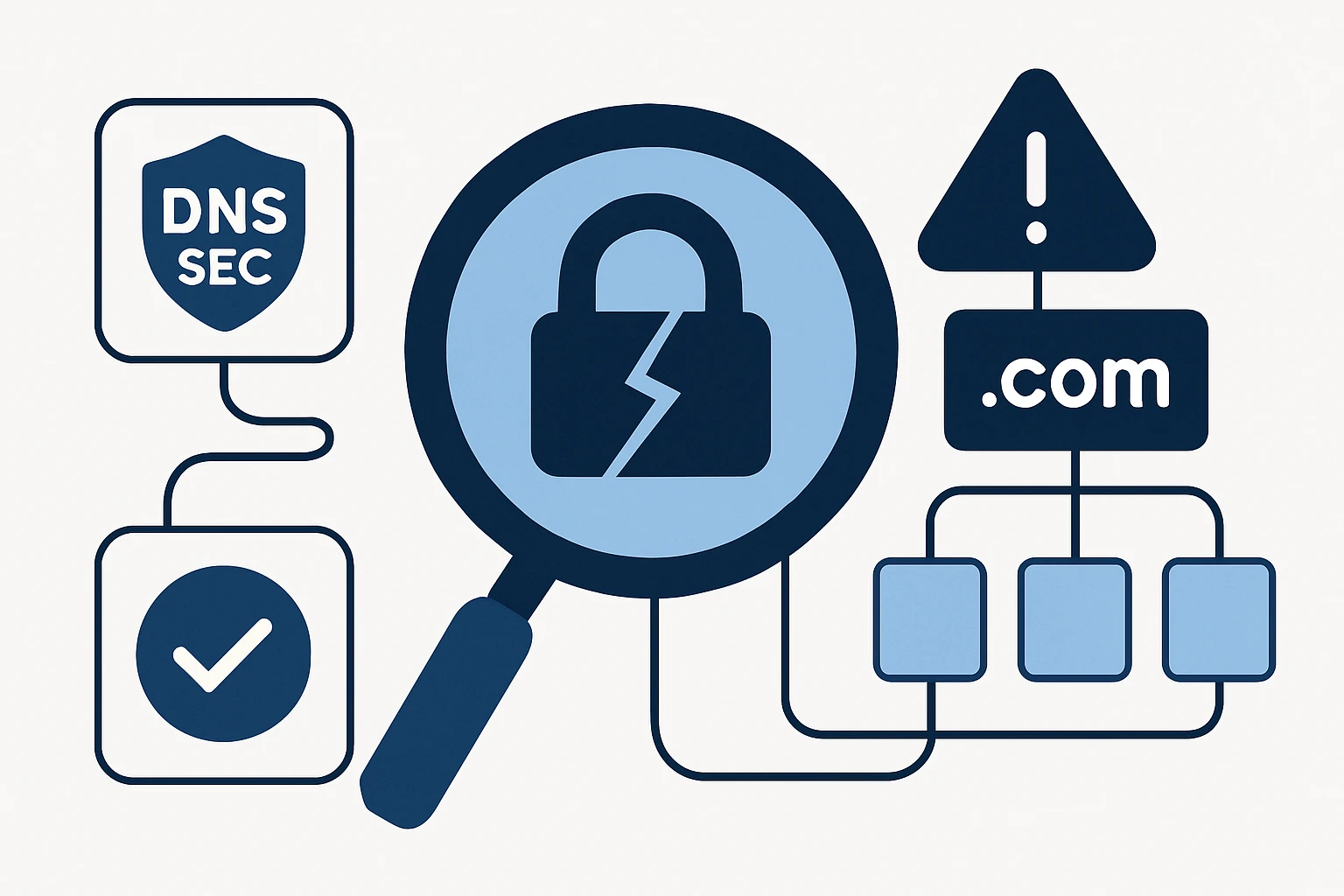
DNSSEC Validation Failures Across a Domain Portfolio: A Diagnostic Framework
When organizations manage a portfolio of domains, DNSSEC validation problems are less about whether DNSSEC is enabled and more about whether the entire chain of trust is consistently maintained across every zone. The practical reality is that a single misconfiguration can produce SERVFAIL responses for dozens or even hundreds of domains, because resolvers validate data by walking a chain from the root to the authoritative zone. ICANN has documented how DNSSEC deployment has progressed across global top-level domains and emphasizes the need for consistent signing and validation across registries and registrars. The consequence for operators is simple: even with DNSSEC in place, misalignments between the parent DS record and the child DNSKEY can render legitimate responses untrustworthy in validation. This is a frequent pain point in multi-domain portfolios, especially during key rollovers and registrar/registry migrations. ICANN: DNSSEC – What Is It and Why Is It Important? and The DNSSEC Chain of Trust describe why the DNSKEY and DS relationship matters for every domain.
The diagnostic framework: a practical, step-by-step approach
The following framework is designed for operators who must coordinate DNSSEC across multiple domains and registries. It emphasizes concrete checks, repeatable workflows, and an understanding of where failures typically originate. The core idea is to validate each link in the chain of trust and to align changes across the entire portfolio before issues propagate to end users.
Step 1 — Confirm signing and validation state for each domain
The first action is to confirm that DNSSEC is actually active on the zone and that resolvers can perform a validation pass. You should see RRSIGs on DNS responses and a signed zone in the authoritative data. If a domain has no DS in the parent or no DNSKEY in the zone, validation will fail at the resolver. This initial check is foundational and guards against assuming DNSSEC is deployed when it isn’t. For a high-level explanation of how DNSSEC validation works, see ICANN’s overview and the chain-of-trust explanation. ICANN — DNSSEC overview • DNSSEC Chain of Trust.
- Verification tools to use: dig +dnssec yourdomain.tld A @nameserver, or online validators like DNSViz-style visualizers to confirm the presence of RRSIG records and the chain of trust.
- What to expect: a signed zone should respond with RRSIGs for signed records; unsigned zones indicate misconfiguration or incomplete deployment.
Step 2 — Check DS presence and alignment with DNSKEY
A DNSSEC-enabled zone must publish a DS record in the parent zone that corresponds to a DNSKEY used to sign the zone. If the DS digest does not match any DNSKEY in the zone, resolvers will reject the data during validation, often returning SERVFAIL. This is one of the most common failures after a key rollover or when delegations are moved between registrars or registries. See standard explanations of how DS and DNSKEY relate and how mismatches cause failures. DS record mistakes and broken delegation and The DNSSEC Chain of Trust.
- Checklist: verify the DS digest algorithm, digest type, key tag, and digest value match a DNSKEY in the zone.
- Common pitfall: publishing a DS record after signing, but with an old digest that no longer matches the DNSKEY post-rollover.
Step 3 — Validate DNSKEY sets against the DS record in the parent
The DNSKEY RRset is the set of public keys used to sign your zone data. The DS record in the parent zone binds one of these keys to the parent, enabling validation to proceed up the chain. If the DNSKEY set changes (e.g., during a rollover) but DS is not updated in the parent, validation will fail for resolvers attempting to validate using the new key. This is a frequent source of SERVFAIL after a rollover or when delegations are migrated. ICANN and DNSSEC education sources explain this chain in detail. ICANN — DNSSEC overview • DS changes during rollover.
- Action item: run a DNSKEY query against your authoritative server and compare to the DS on the registry/parent.
Step 4 — Inspect registry/parent zone for DS presence and accuracy
Even if you publish DS data in the child zone, a missing or outdated DS in the parent will break validation. This situation often arises during registrar migrations or registrar/registry changes where the DS data is not updated in the parent hierarchy in a timely manner. Industry guidance highlights the need for coordination across layers to avoid mismatches. DS migration pitfalls and ICANN — DNSSEC fundamentals.
- Check: DS data must align with the zone’s DNSKEYs; ensure registrar/registry updates have propagated.
Step 5 — Watch for key rollover timing and propagation delays
Key rollovers are a routine operational activity, but they introduce a window where the DS record and DNSKEY row might be out of sync. The timing is tricky because DS propagation sits at the registry/parent zone, while DNSKEY rollover happens in the child zone. If the DS record changes but the new DNSKEY isn’t yet deployed or vice versa, resolvers may respond with SERVFAIL for any queries that cross the boundary. Industry guidance emphasizes planning and testing rollovers with explicit time windows and rollback plans. See guidance on chain-of-trust behavior during rollover and practical troubleshooting tips. ICANN — DNSSEC and rollover considerations • DS changes during rollover.
- Practical tip: document key IDs, algorithms, and rollover timing in a single, auditable plan that spans all domains in the portfolio.
Step 6 — Consider propagation, caches, and TTL effects
Even with correct DS/DNSKEY configuration, cached records and varying TTLs across registries can delay the appearance of updated DS data. If caches retain the old DS digest, resolvers may continue to fail validation until the cache expires. This is a ubiquitous but often overlooked source of confusion for operators, especially in multi-domain portfolios where different TLDs may have different registry/app layer caching behavior. The practical remedy is to align rollover schedules with TTL realities and to communicate expected propagation windows to stakeholders. Industry analyses emphasize this aspect of troubleshooting and propagation. TTL and propagation considerations during DS changes.
- Action item: coordinate with registrars to minimize stale DS in the parent during rollover windows.
Step 7 — Conduct portfolio-wide validation and automation planning
Once you have validated a single domain, the question becomes how to maintain consistency across dozens or hundreds of domains. A portfolio-wide validation workflow reduces the chance of human error during rollovers and migrations. Automation can help ensure that DS data, DNSKEY sets, and related signatures stay synchronized during updates. For a broader view of DNSSEC’s role in a portfolio, see the literature on the chain of trust and practical troubleshooting. DNSSEC chain of trust (DNSimple) and DNSSEC overview (general reference).
- Best practice: maintain a centralized inventory of domains and their DNSSEC state, including root and parent-zone dependencies.
Cross-domain portfolio considerations
For organizations with multi-domain portfolios, the real risk is not a single misconfiguration but misalignment across registries and registrars. To prevent domino effects, implement a coordinated change-control process that includes: (1) a single source of truth for DNSSEC status across all domains, (2) standardized key rollover planning, (3) automated checks that compare DNSKEYs against parent DS data, and (4) a published rollback plan if a rollover introduces validation failures. Industry guidance and practitioner experience converge on the idea that cross-domain coordination reduces risk and speeds up recovery when issues occur. See ICANN’s deployment context and the DNSSEC chain-of-trust literature for more detail. ICANN — DNSSEC fundamentals • DS changes during rollover.
In practice, teams often leverage a domain-portfolio management approach to keep DS and DNSKEY data aligned across all domains. The client-facing utility of such an approach becomes clear when decisions are coordinated across registries with varying interfaces and update cadences. The List of domains by TLDs and Pricing pages illustrate how a centralized inventory and governance model can help organizations maintain consistent DNSSEC posture across a broad set of domains. You can also leverage browser-based RDAP & WHOIS validation to verify domain status across your portfolio via RDAP & WHOIS Database for cross-checks and auditing.
Expert insight
Expert practitioners emphasize that DS-record misconfigurations during key rollovers are among the most frequent root causes of DNSSEC validation failures. The canonical explanations and troubleshooting guidance from DNSSEC experts—ranging from DNSimple’s chain-of-trust discussions to industry blogs—underscore the central role of DS/DNSKEY alignment and registry propagation timing in preventing SERVFAIL. See the detailed treatment in DNSSEC chain of trust and troubleshooting narratives in the field.
Limitations and common mistakes
- Mistake 1: publishing DS records without ensuring the corresponding DNSKEY is in the zone’s DNSKEY RRset.
- Mistake 2: failing to update the DS in the parent zone after a DNSKEY rollover.
- Mistake 3: misaligned TTLs between DS and DNSKEY-related data leading to cache-era mismatches.
- Mistake 4: assuming cross-TLD propagation is instantaneous; registries have independent caches and update cadences.
- Limitation: even perfectly configured zones can experience resolver-specific quirks; end-user validation may vary by resolver and network path.
Practical troubleshooting checklist you can apply today
- Confirm signing status for each domain and check for RRSIG on a baseline record.
- Validate DS records in the parent zone exactly match a DNSKEY in the child zone (digest, algorithm, key tag).
- Verify the DNSKEY set is the same one used for zone signing and that the DS digest corresponds to one of the DNSKEYs.
- Inspect registry/parent DS data for presence and accuracy; request updates if propagation is lagging.
- Review key rollover timing; ensure DS updated before DNSKEY or plan a controlled rollback if problems arise.
- Consider propagation windows and TTL alignment across registrars; coordinate with registrars to minimize stale data.
- Apply portfolio-wide automation to compare DNSSEC states across domains and surface outliers for rapid remediation.
Conclusion
DNSSEC delivers strong security by authenticating DNS responses, but the practical reality is that the reliability of DNSSEC depends on disciplined, portfolio-wide management of DS and DNSKEY data, registrar/registry synchronization, and careful rollback planning during key rotations. A structured diagnostic framework—rooted in the chain of trust, DS/DNSKEY alignment, and propagation realities—can turn what feels like a technical lottery into a repeatable, auditable process. For teams seeking a practical path to mature DNSSEC posture across a multi-domain portfolio, combining rigorous internal workflows with centralized domain inventory and verification tools is the most reliable route.
For organizations evaluating domain portfolios and the tools to manage DNS data, consider the portfolio-management capabilities demonstrated by WebAtLa, which offers a centralized view of domains by TLD, countries, and technologies, along with RDAP/Whois validation and transparent pricing. This ecosystem can help teams maintain DNSSEC readiness across diverse registries and geographies. See List of domains by TLDs, List of domains by Countries, and Pricing for context.
Sources and further reading: ICANN — DNSSEC overview, DNSSEC chain of trust, DS changes during rollover, ICANN — DNSSEC fundamentals, DNSSEC Validation Failed: Troubleshooting guide.