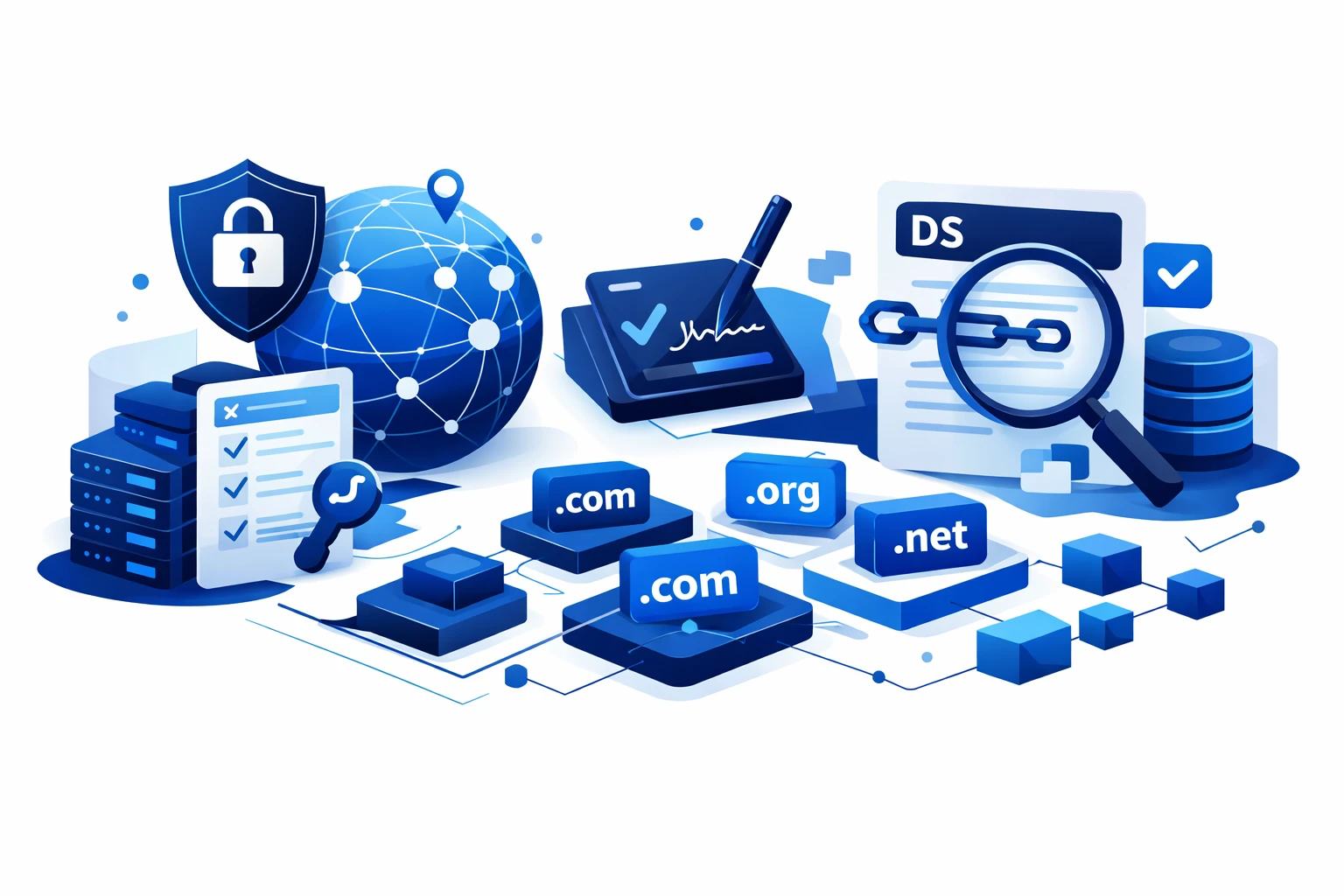
DNSSEC is more than a technical spec—it's a governance and operations problem for any organization with a portfolio of domains. For teams managing multiple TLDs (for example .ae, .sg, or .group), the challenge isn't just signing zones, but aligning DS publication across registries, coordinating key rollovers, and ensuring end-user validation is ubiquitous. This article presents a practical Readiness Playbook for multi-TLD DNSSEC deployments, focusing on inventory, signing strategy, DS publication across registries, validation, monitoring, and governance. The goal is a repeatable, low-friction process you can implement in 30–60 days and adapt for future portfolio growth.
Effective DNSSEC governance starts with visibility: you must know what you own, where it’s hosted, and how each domain is configured for DNSSEC. Without a verified inventory, even well-intentioned deployment efforts can drift out of sync, leaving domains with partial signing, stale DS data, or mismatched key material. The framework below blends practitioner experience with industry guidance to help you operationalize DNSSEC across a diverse TLD footprint.
Inventory as the Foundation of DNSSEC Readiness
A complete inventory sets the baseline for all subsequent DNSSEC work. Without knowing what you own, where it’s hosted, and how each domain is configured for DNSSEC, you risk misalignments that lead to validation failures for users and business-critical downtime. The inventory should be treated as a living artifact, updated as you acquire or retire domains.
- Audit domain estate across TLDs: compile the list of all domains, including ccTLDs and gTLDs, and map them to their registrars and DNS providers. A consolidated view makes it easier to plan DS publication and key rollover without blind spots.
- Validate zone signing status: for each domain, check if DNSKEY and DS exist, and whether signatures are active for the signed zones. If a domain is unsigned while its parent zone contains a DS, resolvers will report validation failures for users.
- Document parent-child relationships: ensure you know the parent DS status and whether it’s up-to-date with current DNSKEYs. Misalignment here is a frequent source of service outages during rollover events. (aws.amazon.com)
- Identify critical assets: prioritize domains used for payments, authentication, or customer data. In practice, having DS healthy on these domains reduces risk of customer-facing errors during DNSSEC events.
- Inventory governance contacts: collect registrar and DNS provider contacts, change windows, and escalation SLAs to accelerate crisis response.
From a practical perspective, a robust inventory also informs the cross-TLD complexity of DS publication. Registries operate independently, and DS publication must be coordinated across parent zones to prevent validation gaps. For organizations using diverse registrars or hosting providers, this inventory is the map you’ll rely on during every signing cycle and registrar change. Guidance on DS publication and signing cadence can be found in industry deployments and provider articles. (aws.amazon.com)
Signing and Key Management: KSKs, ZSKs, and Practical Rollover Policies
DNSSEC relies on two types of cryptographic keys: the signing keys (ZSKs) used to sign zone data and the key signing keys (KSKs) used to sign DNSKEY records in the zone. Best practice advocates a separation of duties: keep KSKs in a more controlled, less frequently rotated lifecycle and use ZSKs for day-to-day signing. This separation minimizes risk, limits exposure during rollover, and simplifies DS updates at registries. The DNS Institute’s practical guidance emphasizes distinct KSK and ZSK usage and outlines common rollover patterns that preserve trust chains across parent zones. (dnsinstitute.com)
Key rollover is inevitable in long-lived DNSSEC deployments. When a KSK or DS data changes, you must coordinate a DS publication at the parent zone and ensure the old DS remains resolvable until caches expire. A typical approach is to publish a new DS for the upcoming KSK well before the old DS retires, then plan for a controlled deprecation of the previous key. Registry-specific delays and caching behavior mean that you should build a staged schedule and test in staging domains when possible. The AWS Route 53 guidance and DNSSEC deployment literature describe these mechanics and emphasize avoiding gaps in the trust chain during transitions. (aws.amazon.com)
- Define a signing cadence: establish how often you rotate ZSKs and under what conditions you rotate KSKs. Include a concrete calendar and rollback plan.
- Enforce a KSK/ZSK separation: use a dedicated KSK for DNSKEY signing; use a separate ZSK for signing zone data.
- Plan DS rollover windows: align DS publication with registry propagation times to avoid validation gaps.
- Maintain a key inventory: track key IDs, algorithm, and expiration dates; set automated alerts for impending rollovers.
- Test changes in a staging domain: before committing to production, validate DS and DNSKEY correspondences in a non-critical domain.
In practice, a well-documented signing policy reduces operational risk and keeps your portfolio ready for growth. As a reminder, if you change DNSKEY material, you must publish a corresponding DS record at the parent zone; otherwise, validation will fail for users who rely on DNSSEC. See the canonical guidance from registry and cloud DNS providers for concrete stepwise procedures. (aws.amazon.com)
DS Publication Across Registries: A Coordination Playbook
DS publication is the mechanism that links your signed zone to the global DNS trust chain. The DS record must be published in the parent zone by the registry, and discrepancies between the zone data and the DS data produce immediate validation failures for resolvers. In multi-TLD portfolios, the challenge multiplies as each registry enforces its own processes and propagation timelines. The practical takeaway is to orchestrate DS publication as a cross-registrar process with explicit responsibility owners, documented windows, and automated checks. (help.dyn.com)
Effective DS publication across diverse registries benefits from a staged, test-first approach. Before a production change, validate DS at the parent with a controlled domain that mirrors production behavior, then monitor resolver validation across multiple networks. Registry propagation times vary; you should plan for a window of 24–48 hours or more depending on TTLs and registry queues. This pattern is echoed in published deployment guides and real-world customer cases. (aws.amazon.com)
- Pre-publish validation: validate DNSKEY and DS pairings in a staging environment or a non-critical domain that uses the same signing keys and algorithms.
- Publish DS to each parent zone: follow each registry’s procedure for DS publication and record the official date/time of publication.
- Coordinate with registrars: ensure your registrar accepts DS updates without requiring a ticket, or has a clear SLA for changes.
- Monitor propagation: use cross-network DNS checks to verify that DS and DNSKEY are visible in resolutions across multiple resolvers.
- Establish a restoration plan: in case of unexpected delays or misconfigurations, know exactly how you’ll rollback or pause the rollover safely.
From a portfolio perspective, this coordination is easiest when you centralize visibility: a single inventory, a single change-management approach, and consistent testing across all registries involved. The end result is a durable, auditable trail of DS publication across all relevant TLDs.
Validation, Monitoring, and End-User Experience
DNSSEC validation is only as valuable as the real-world experience it enables. Validation success across a broad set of resolvers translates to fewer user-visible errors and more stable security postures for domain-using applications. However, validation coverage is uneven—some resolvers do not perform DNSSEC validation, and misconfigurations can slip past automated checks if monitoring is infrequent. Researchers have documented substantial misconfigurations in DNSSEC deployments, and practical monitoring should aim to detect misconfigurations before customers are affected. (arxiv.org)
Operational monitoring should track both technical and business metrics:
- Technical validation: verify that DNSKEY records validate for a representative set of resolvers, and confirm that DS data matches the DNSKEYs in your zone.
- Trust-chain health: ensure there are no stale DS records in parent zones and that DNSKEY rollover anniversaries are tracked.
- Resolver coverage: measure the fraction of end users whose resolvers perform DNSSEC validation, and monitor for sudden drops.
- End-user experience: monitor changes in DNS resolution latency and error rates around signing and DS publication events to identify regressions quickly.
Modern measurement studies emphasize that misconfigurations—not just DNS performance—drive real-world validation failures. A robust validation program complements configuration discipline and helps maintain user trust during and after rollout. (arxiv.org)
Nuances Across TLDs: The Real-World Differences You Must Plan For
Although DNSSEC principles are universal, the operational realities vary by registry and TLD. For example, some registries require DS publication to be completed before DNSKEY changes take effect, while others allow staggered or delayed propagation windows. In portfolios that include diverse TLDs—like .ae, .sg, and .group—team members must account for registry-specific constraints when planning key rollovers and DS updates. Real-world deployment experiences underscore the importance of pre-validated, cross-registrar workflows and clear escalation paths for registrar-related issues. (aws.amazon.com)
- Registry-specific propagation times: even when zones are signed and DS records are published, registries can introduce delays that affect validation at the edge.
- DS lifecycles by TLD: different TLDs may have different expectations for DS record lifetimes and TTLs; plan accordingly.
- Cross-TLD governance: document ownership across registries to ensure DS publication and key rollover events do not become bottlenecks.
For teams managing inventory across TLDs, the practical takeaway is to tailor the readiness plan to registry realities while preserving a consistent, auditable process across all domains. If you’re looking to inventory a broad portfolio or identify specific TLD edge cases, tools and partner services can help you map your estate and progress more quickly. For example, registries and providers commonly offer a consolidated view of your domains and their DNSSEC status, which can be a first-pass input to your readiness plan.
DS Readiness Framework (DS-PREP): A Practical, Repeatable Playbook
To translate the concepts above into actionable steps, adopt a lightweight framework you can run quarterly or on-demand as your portfolio changes. Below is a compact, stage-based outline you can adapt to your organization’s size and risk tolerance. Each stage includes core activities and the expected output, with the aim of delivering a production-ready DNSSEC posture across all applicable TLDs.
- Stage 1 — Inventory: complete an estate map, categorize domains by criticality, identify registrars, and document DNS providers. Output: a canonical inventory, updated quarterly.
- Stage 2 — Signing Policy: define ZSK/KSK usage, signing cadence, and protection controls for keys. Output: documented signing policy and key inventory.
- Stage 3 — DS Publication Readiness: establish a registrar-facing workflow for DS updates, and build a test plan to validate DS/DNSKEY pairings before production. Output: DS publication playbook and test results.
- Stage 4 — Validation & Monitoring: implement cross-resolver validation checks, track DS expiry alerts, and monitor resolution performance during rollover windows. Output: monitoring dashboards and alert rules.
- Stage 5 — Governance & Change Control: codify escalation paths, change windows, and stakeholder ownership to ensure sustained readiness. Output: governance charter and change-management logs.
Adopting DS-PREP helps you convert ad hoc DNSSEC work into a repeatable process, which is especially valuable when your portfolio expands to new TLDs or when you introduce new registrars. The emphasis on test-first DS publication, staged rollovers, and ongoing validation aligns with industry best practices and helps you avoid common missteps.
Limitations and Common Mistakes to Avoid
DNSSEC deployment is not a one-off configuration; it is an ongoing process that requires discipline and visibility across teams and registries. Below are some of the most frequent limitations and mistakes observed in real-world deployments, along with concrete mitigations.
- Mistake: Rotating KSKs without updating DS: if you publish a new KSK but fail to update the DS record at the parent zone, validators will fail, and users will see DNS errors. Mitigation: coordinate KSK rollover with DS publication across all registries and verify DS at the parent after each change. (aws.amazon.com)
- Mistake: Assuming all resolvers perform DNSSEC validation: validation coverage varies by resolver; some users may see non-validated results even when your zone is signed. Mitigation: measure validation reach across networks and adjust monitoring accordingly. (arxiv.org)
- Limitation: Registry delays and caching windows: DS propagation and DNSKEY signature caches can introduce unseen gaps if not anticipated in the change window. Mitigation: build a staged rollout with explicit timings and validation checkpoints. (aws.amazon.com)
- Common pitfall: Mismatched signing and DS data: a mismatch between DNSKEYs in the zone and the DS data in the parent will break validation; this is a frequent root cause of outages after changes. Mitigation: run end-to-end tests in staging and validate both sides before production. (help.dyn.com)
- Limitation: Underestimating governance scope: without clear ownership and change windows, DNSSEC changes can stall during vendor transitions or domain acquisitions. Mitigation: formalize a DNSSEC governance charter aligned with portfolio management. (aws.amazon.com)
- Misstep: Overly aggressive DS lifetimes or too-long DS cache lifetimes: long-lived DS data can delay detection of misconfigurations and complicate rollovers. Mitigation: set sensible TTLs and alert calendars around rollover events. (security-informatics.springeropen.com)
Practical, Real-World Notes for a Multi-TLD Portfolio
For teams operating across diverse TLDs, the following pragmatic reminders help you stay aligned with the readiness framework while keeping overhead manageable:
- Dedicate a domain-portfolio owner per registry: assign responsibility for DS publication, DNSKEY management, and DS record updates to reduce handoffs and delays.
- Keep a running calendar of rollovers: KSK and DS rollovers require coordination across registrars; a shared calendar with reminders helps avoid last-minute surprises.
- Test, test, test: leverage staging domains that mirror production, and run end-to-end checks for DS/DNSKEY alignment before each production change.
- Inventory-driven discovery: use your estate map to identify domains that rely on DoT/DoH providers or specific resolvers, as these can influence validation behavior for end users.
- Leverage partner tooling for cross-TLD inventory: a consolidated view of domains by TLD simplifies detection of gaps in DS state when new domains are added.
Regarding domain lists and portfolio inventories, you can start with a tangible, actionable inventory for your multi-TLD estate by reviewing your registry pages and domain inventory. For example, you can focus on inventorying .ae domains on the dnssec.me client view for .ae-specific inventory and DS readiness, or explore other lists by TLD on the same platform. See the following pages for practical entry points: download list of .ae domains, domain inventory by TLDs, and RDAP & WHOIS database for ownership and registration details.
Conclusion: A Practical Path to DNSSEC Maturity Across a Diverse Portfolio
DNSSEC readiness across a multi-TLD portfolio is a function of visibility, disciplined signing, careful DS publication, vigilant validation, and proactive governance. The playbook outlined here—centered on a living inventory, a clear signing policy, cross-registrar DS publication rituals, robust validation/monitoring, and a lightweight DS-PREP framework—offers a practical way to move from scattered pilots to an auditable, scalable DNSSEC program. Importantly, you do not need a perfect, one-size-fits-all solution today to start. Begin with your most critical assets, establish a repeatable process, and extend it to additional domains as you gain confidence and improve automation.
Real-world deployments continue to reveal that the value of DNSSEC grows with disciplined governance and end-to-end validation. While each registry has its own quirks, a consistent framework helps you navigate the differences and reduce the risk of misconfigurations or missed DS updates. For teams ready to begin, the inventory and registry-backed DS publication pieces are often the most underinvested yet most impactful components of a resilient DNSSEC program.
If you are starting from scratch or expanding an existing portfolio, consider using the portfolio inventory tools and registrant data available on the client pages to map your estate and prioritize DS-related actions across TLDs. For a broader view of your domains by TLD or country, the dedicated listing pages can accelerate your readiness process: domain inventory by TLDs and RDAP & WHOIS database.