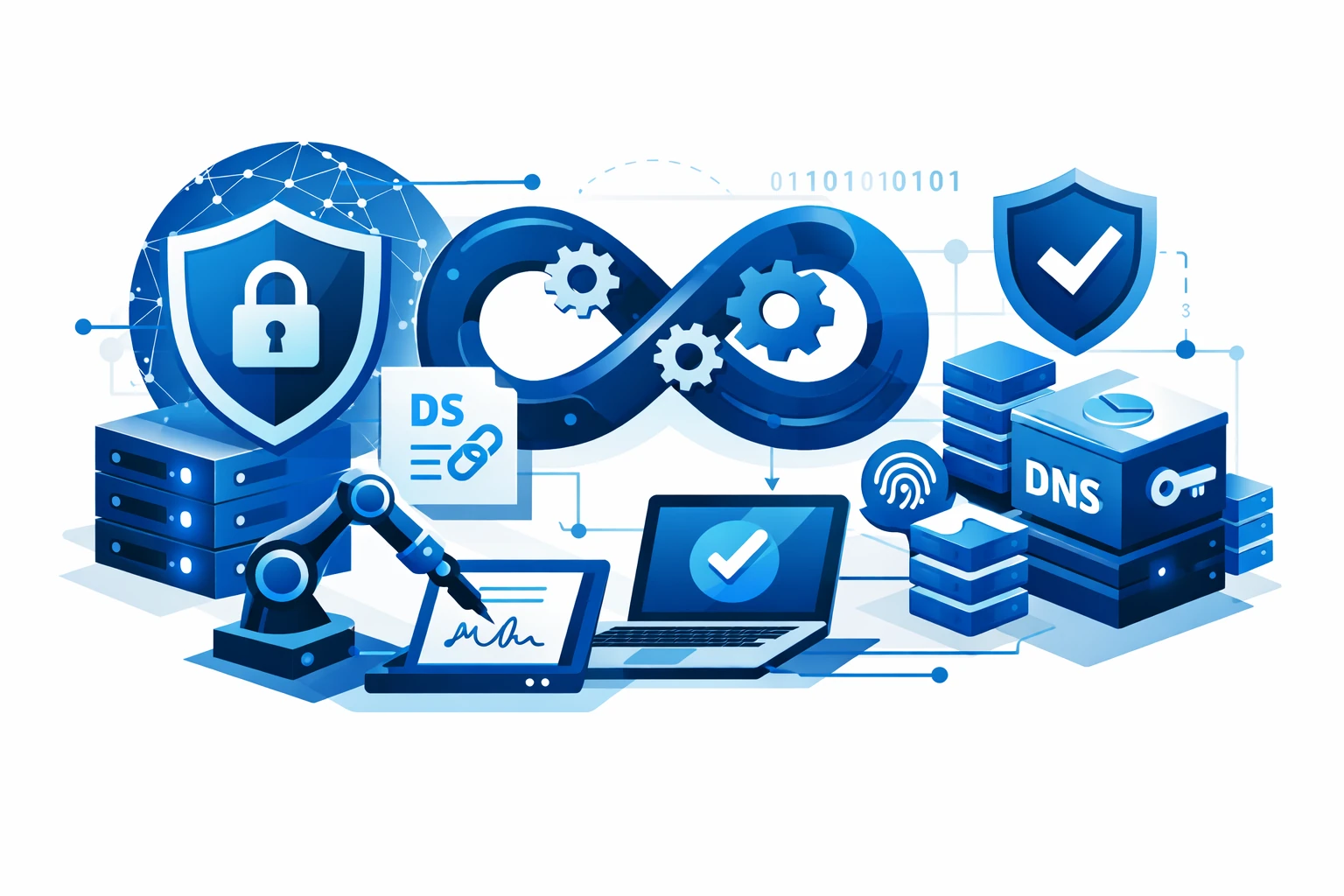
Introduction: DNSSEC as a DevOps problem, not just a security feature
As organizations shift more infrastructure and applications into automated pipelines, the way we think about DNS security evolves from a manual, one-off configuration into a software-delivery problem. DNSSEC adds cryptographic assurances that protect against spoofing and data manipulation in the DNS, but to gain those benefits at scale, you must treat zone signing, DS publication, and trust-anchor maintenance as repeatable, auditable processes integrated into your CI/CD playbooks. In practice, this means codifying signing parameters, automating DS publication where supported by registries, and continuously validating the chain of trust across domains and environments. The result is a more resilient DNS footprint with fewer human errors and faster rollout of new zones and changes. Expert insight: automation reduces the risk of misaligned keys and stale DS records, but it also raises the bar for operational discipline—your tooling must handle key lifecycles, registry limitations, and validation failures with clear fail-safes. (cloudflare.com)
What you need to know before you automate
DNSSEC introduces several moving parts: DNSKEYs (the public keys for signing), RRSIGs (the digital signatures over DNS data), DS records (the delegation signers published in the parent zone), and in modern practice, CDS/CDNSKEY records that help automate DS publication. A zone participates in a chain of trust from the DNS root down through each delegated zone. The root has a trust anchor that resolvers use to validate every signed zone, and this trust anchor is rotated periodically as cryptographic material evolves. Understanding these pieces is essential before you start writing automation. Key takeaway: automation hinges on reliable key management, accurate DS publication, and robust validation across resolvers. (rfc-editor.org)
Core concepts refresher: what to automate and why it matters
For teams new to the automation angle, here are the core terms and their significance in DevOps workflows:
- DNSKEY: The public key (or keys) used by the zone to sign its data. The private key signs the zone data; the public key is distributed via DNSKEY records. Automating DNSKEY rotation is a critical capability to maintain cryptographic freshness. (cloudflare.com)
- ZSK vs KSK: Zone Signing Keys (ZSKs) sign zone data, while Key Signing Keys (KSKs) sign the DNSKEY RRset itself. The KSK often has a longer lifetime and becomes part of the DS record published at the parent zone. Managing both in automation is essential. (rfc-editor.org)
- DS record: The Delegation Signer (DS) record binds a child zone to its parent zone’s trust by hashing the child DNSKEY and publishing the hash in the parent. A mismatch between DS and DNSKEY is a common cause of validation failures; automation helps ensure DS reflects current keys. (cloudflare.com)
- CDS/CDNSKEY: Child DS and Child DNSKEY records designed to simplify DS publication by enabling registrars to pick up the DS data automatically when child keys change. Not all registrars support full CDS/CDNSKEY workflows, so your automation must handle variations across registrars. (docs.debops.org)
- DS publication workflows: The workflow that propagates DS data from the child to the parent zone remains a practical choke point; where supported, CDS/CDNSKEY can dramatically reduce manual steps. Where not supported, you’ll still need a reliable process to update DS records at the registrar. (liveconfig.com)
Modern safety practices also emphasize validation as a continuous activity. Validation should happen not only inside your authoritative zones but also at the resolver layer, ensuring that trust remains intact as keys rotate and DS records update. This is where testing, monitoring, and alerting come into play alongside signing automation. (ibm.com)
A practical 4-stage CI/CD workflow for DNSSEC automation
Think of DNSSEC automation as a four-stage pipeline that mirrors typical software delivery pipelines: inventory, signing, DS publication, and validation. Each stage is designed to be idempotent, observable, and recoverable.
Stage 1 — Inventory and policy definition
- Assemble a definitive inventory of zones under management, including registrar capabilities, DS support (and any CDS/CDNSKEY support), and current key material lifecycles. An accurate inventory prevents drift and misapplied policies when new zones are onboarded.
- Define signing policy: key lifetimes (ZSK/KSK), rollover windows, and algorithm choices. Align with industry best practices and any regulator expectations your organization faces. Insight: a well-defined policy reduces the risk of silent, out-of-date signatures and mismatched DS records. (docs.oracle.com)
- Establish a trust anchor management plan, including how you refresh root trust anchors in your resolvers and what you do if a root DST (trust anchor) changes. The root trust anchor is periodically updated by IANA and must be accommodated in validation workflows. (iana.org)
Stage 2 — Signing and key management
- Choose a signing toolset and integrate it into your CI/CD. OpenDNSSEC is a widely used, policy-based signer that automates key management and signing across zones, reducing manual toil. (opendnssec.org)
- Automate the lifecycle of DNSKEYs, including generating ZSKs and KSKs, publishing DNSKEYs to the zone, and triggering signatures over RRsets. Automation should preserve the ability to perform manual overrides in emergencies and support planned rollovers. (opendnssec.org)
- Parameterize signing windows to minimize signature churn and ensure signatures are available before DS publication windows. A common practice is to coordinate KSK rollovers with the parent publication timeline to avoid validation gaps. (docs.oracle.com)
Stage 3 — DS publication and registrar integration
- Publish DS records in the parent zone to complete the chain of trust. Validation failures often trace back to DS that does not reflect the current DNSKEY set. Automating DS generation from DNSKEY material and pushing it to the registrar reduces this class of errors. (cloudflare.com)
- Utilize CDS/CDNSKEY where registrars support them to streamline DS publication. If a registrar does not support automated CDS/CDNSKEY updates, implement a monitored, manual fallback with precise change windows to avoid propagation gaps. (docs.debops.org)
- Coordinate DS publication timing with DNSKEY availability and zone signing status, and maintain a rollback plan if a DS does not propagate correctly. Some platforms require you to wait for DNSKEY TTLs before removing old DS; automation should reflect this constraint. (docs.oracle.com)
Stage 4 — Validation, monitoring, and incident response
- Validate that every signed zone provides valid signatures (RRSIGs) and that the trust chain remains unbroken across resolvers. Use robust, independent validation checks to detect broken chains before customers notice. (ibm.com)
- Monitor resolver behavior and DNSSEC validation status at scale. Real-time dashboards should flag domains where DS or DNSKEY records differ from the parent key state or where signatures fail to validate. (cloudflare.com)
- Automated alerting and rollback hooks are essential: if validation fails, you should automatically halt deployments that would push invalid signatures or DS states and trigger a controlled remediation workflow. (rfc-editor.org)
Tools and integration patterns you can adopt today
There are several practical tooling patterns you can adopt to realize the four-stage workflow described above. The goal is to choose a combination of signing, publication, and validation capabilities that matches your registrar’s API surface and your portfolio scale.
- Signing and key management tooling: OpenDNSSEC provides policy-based signing and key lifecycle management, which can be embedded into CI/CD runs. This reduces manual keystroke errors and ensures consistent signing behavior across zones. (opendnssec.org)
- Automation of DS publication: CDS/CDNSKEY records are designed to automate the DS publication step by the parent zone. When supported, they can dramatically shorten the window during which a new DNSKEY is visible but not yet trusted by resolvers. Where not supported, you’ll need a registrar-integrated workflow to push DS records and align propagation with signing activity. (docs.debops.org)
- Registry and registrar integration: In practice, registrars differ in how they expose DS updates (APIs, support tickets, or manual portals). Build explicit, unit-tested playbooks for each registrar type and maintain a failsafe manual override path. Some practitioners rely on CDS/CDNSKEY to minimize manual steps, while others maintain a separate DS publishing scaffold for registrars that lack API automation. (liveconfig.com)
- Validation tooling: Validation begins where the data is signed—within the zone—and extends to resolvers across the Internet. Use both in-zone validation (RRSIG presence, DS match) and out-of-band checks against root trust anchors to catch issues early. (ibm.com)
Case study: a hypothetical SME portfolio embracing DNSSEC automation
Imagine an SME portfolio managing 25 domains across several TLDs with varying registrar capabilities. The IT team decides to implement a CI/CD-backed DNSSEC workflow with OpenDNSSEC for signing and CDS/CDNSKEY-assisted DS publication where the registrars support it. The plan proceeds as follows.
- Inventory: The team inventories all zones, registrar capabilities, and current DS/DNSKEY state. They categorize zones by registrar and whether CDS/CDNSKEY workflows are available.
- Policy: They define a policy to rotate ZSKs every 6–12 months and KSKs every 12–24 months, with a staged rollover window to align with DS publication cycles. They document a rollback plan for failed rollovers.
- Signing: OpenDNSSEC is configured to sign all zones with a consistent algorithm suite, with automatic rollover events scheduled in the deployment pipeline.
- DS publication: For registrars that support CDS/CDNSKEY, the pipeline pushes child key material automatically to the registrar and updates DS accordingly. For others, an integration layer triggers registrar DS updates through API calls or manual tickets with a tight change window.
- Validation: After signing and DS publication, the team runs automated checks that the DNSKEY/RRSIG/DS chain resolves in validation mode across multiple resolvers and validates the root-anchored chain. Alerts are configured for any mismatch or validation failure.
In the real world, this approach dramatically reduces human error and accelerates deployment of new zones, while also introducing a new set of operational requirements—such as registrar API reliability, robust monitoring, and explicitly documented rollback procedures. The core ideas—trust anchors, chain of trust, and DS-based delegation—remain the same, but the delivery model shifts toward repeatable, testable automation. (opendnssec.org)
Client integration: how a domain portfolio partner can help you succeed
A domain-portfolio or registrar partner can provide essential data and services that complement your automation roadmap. For example, a partner offering domain inventories by TLD can help you quickly normalize your zone list and identify registrar-specific constraints. See how a comprehensive domain inventory by TLD and country could fit into your workflow at: domain inventory by TLD and RDAP & WHOIS database. These resources can help you map zone ownership to signing and DS publication responsibilities across the portfolio. Additional cost and policy information may be found at pricing, which helps teams plan the economics of automated DNSSEC at scale. (liveconfig.com)
Limitations and common mistakes to avoid
- Assuming all registrars support CDS/CDNSKEY: Some registrars still require manual DS updates or tickets for DS changes. Rely on CDS/CDNSKEY where available, but maintain a clear fallback process for registrars that lack automation support. This mismatch is a frequent source of deployment delays. (docs.debops.org)
- Ignoring registrar propagation windows: DS records and DNSKEY rollovers have propagation windows. Removing old DS records before the new DS is visible to resolvers can cause validation failures. Build explicit sequencing into the pipeline and consider TTLs and registrar update latency. (docs.oracle.com)
- Over-reliance on a single signing tool: While tools like OpenDNSSEC automate many tasks, they introduce operational dependencies. Ensure your pipeline includes monitoring, testing, and the ability to run emergency manual signings if automation fails. (opendnssec.org)
- Inadequate validation coverage: DNSSEC validation should be tested beyond your own resolver; peak reliability comes from cross-checking trust across a broad set of resolvers and ensuring root trust anchors remain current. Continuous validation reduces the likelihood of silent failures in the wild. (ibm.com)
Expert guidance and a few cautions
Experts emphasize that DNSSEC deployment is not just a technical exercise; it is a governance and operations challenge. A well-structured automation plan must address policy, process, and people as much as it addresses code. A strong governance approach includes documented key rollover schedules, clearly defined rollback paths, and a dedicated ownership model for keys and DS publication. In practice, automation widens the scope of what operators are responsible for and raises the bar for incident response and change control.
One practical limitation to keep in mind: even with automation, there can be legacy domains or edge cases where DS publication is not immediate due to registrar constraints. Plan for staged deployments and ensure you have a clear, tested manual-overrides path. This pragmatic stance helps balance the benefits of automation with the realities of regression risk and registrar variability. (liveconfig.com)
Conclusion: DNSSEC automation as a disciplined, scalable practice
Automating DNSSEC across a portfolio is a valuable way to translate cryptographic protection into reliable, repeatable delivery. When approached as a DevOps problem—defining inventory, policy, signing, DS publication, and validation as a cohesive pipeline—teams can achieve faster, more reliable deployments with fewer operational errors. The core concepts remain rooted in DNSSEC fundamentals: DNSKEY and DS records form the basis of trust, CDS/CDNSKEY offer a practical path to automation where registrars support them, and root trust anchors provide the ultimate safety net. Practice good governance to ensure that automation remains resilient in the face of registrar quirks, registry delays, and changing cryptographic standards.
For teams ready to embark, the payoff is substantial: fewer manual steps, faster onboarding of new zones, and a more verifiably secure DNS surface for customers and services. As DNSSEC adoption grows, a disciplined, DevOps-informed approach to signing, publication, and validation becomes not just beneficial but essential. (rfc-editor.org)