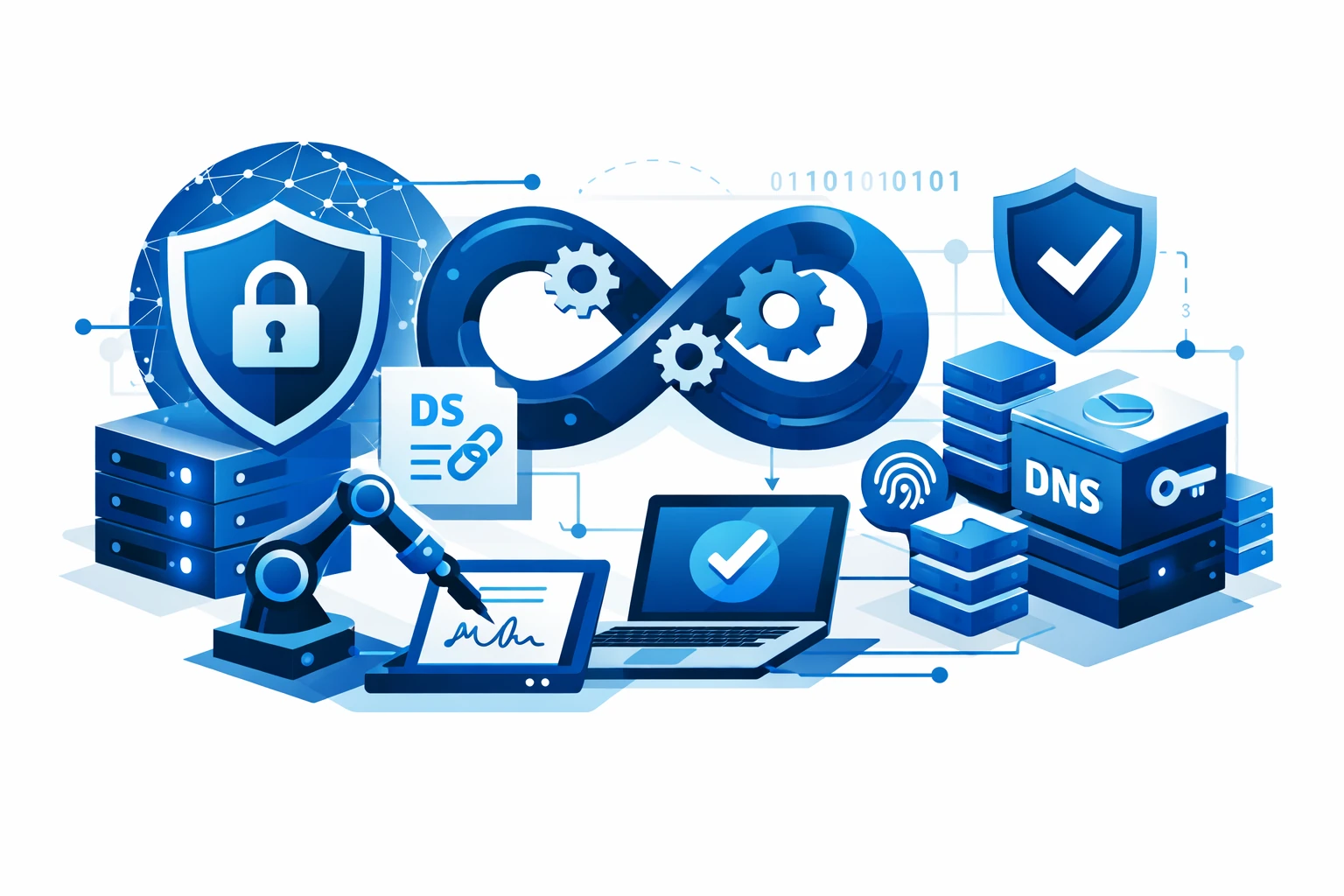
Introduction: why DNSSEC matters for brand protection and regulatory compliance
Domain-portfolios—whether managed in a multinational enterprise or a fast-growing SaaS provider—face a common threat profile: DNS-based manipulation or misdirection that harms brand integrity and undermines trust. DNSSEC is not merely a technical feature at the edge of the DNS system; it is a governance and risk-management control that enables verifiable authenticity and data integrity for domain responses across zones. In practical terms, DNSSEC helps ensure that the DNS data your users receive originates from your authoritative sources and has not been tampered with in transit. This is particularly important for brands operating across many TLDs and jurisdictions, where DS publication and key management intersect with regulatory expectations and third-party audits. Verisign emphasizes that DNSSEC validation helps confirm both origin and integrity, which is a core component of a mature domain-security program. “DNSSEC validation helps to assure users that the data originated from the stated source and that it was not modified in transit.” (verisign.com)
A quick refresher: how DNSSEC creates the chain of trust
DNSSEC extends the DNS by introducing cryptographic signatures that bind zone data to public keys. The chain of trust starts with a root or top-level delegation, where a DS (Delegation Signer) record is published in the parent zone and points to the child zone’s DNSKEY (the public keys that verify signatures). When a resolver queries a signed zone, it follows signatures (RRSIG records) and key information to verify that the answer really came from the authoritative source and remains unmodified. A failure anywhere along this chain—missing DS records, expired keys, or signature mismatches—breaks validation and signals a potential security concern. Cloudflare’s overview of the mechanism highlights the DS→DNSKEY linkage as the essential trust transfer point, while also illustrating the role of the signed data (RRSIG) in validation. “A zone operator hashes the DNSKEY record containing the public KSK and gives it to the parent zone to publish as a DS record.” (cloudflare.com)
In practice, every zone in a secure chain must maintain active signing, a current DS record at its parent, and robust key-management practices. Verisign has long discussed the evolution of DNSSEC, including operational implications of validation and the historical role of signature schemes in preserving data integrity, which remains central to a governance-driven security program. “The DNSSEC protocol… is a layer of authentication security added to the DNS that preserves the integrity of DNS data by ensuring any altered data can be detected and blocked.” (verisign.com)
DNSSEC in the governance and regulatory landscape
Beyond technical safeguards, DNSSEC intersects with governance, risk management, and regulatory expectations. Demonstrating a formal DNSSEC program—with signed zones, DS maintenance, and monitoring of validation outcomes—can support audit trails and vendor assessments. ICANN’s DNSSEC FAQs explain the mechanism and the rationale for root and TLD deployment, while also outlining the benefits in terms of security posture and resilience. For organizations facing regulatory scrutiny or contractual obligations related to data integrity and system integrity, a consistent DNSSEC implementation across a domain portfolio offers concrete evidence of due diligence and risk mitigation. “DNSSEC deployment… set the stage for improved security and stability of the Internet’s domain namespace.” ICANN’s materials on DNSSEC provide foundational context for how and why these records matter at scale. (icann.org)
Supported by technical communities and industry leaders, DNSSEC is increasingly treated as a governance asset—an auditable control that complements privacy, access controls, and incident response planning. The practical implication for portfolio managers is clear: align signing practices, DS publishing, and validation monitoring with internal risk controls and external reporting requirements. For teams, this means documenting ownership of DS lifecycle events, scheduling KSK rollover exercises, and coordinating with registrars and registries to ensure DS records propagate correctly across all relevant TLDs. As the field evolves, industry sources emphasize that DNSSEC is not a “set-and-forget” feature but a continuous governance discipline supported by monitoring and change-management practices. “DNSSEC validation is essential for ensuring that data is authentic and intact,” which is a principle that underpins the operational rigor of modern domain portfolios. (cloudflare.com)
From DS to DS: the practical mechanics for a multi-domain portfolio
Central to the DNSSEC workflow is the relationship between the child zone and its parent. The child zone signs its data with DNSKEY records (public keys) and publishes signatures (RRSIG). The parent zone contains a DS record that encodes a digest of the child’s DNSKEY. This digest is what the resolver uses to verify the child zone’s signatures. In a large portfolio, the operational challenge is to keep DS records in sync with DNSKEYs across dozens or hundreds of domains and to ensure that all parent zones (across TLDs) reflect the current digest after key-rollovers. In practice, this is where automation, governance, and observability converge. DNSSEC advocacy groups, along with providers like Verisign and Cloudflare, emphasize the DS relationship as the critical link in the chain of trust and the primary target for correct lifecycle management. “The zone-signing function for the root zone is… published in the parent zone as DS.” The mechanics are well-documented in public resources that describe the DS→DNSKEY linkage and the importance of timely DS updates to prevent validation failures. (cloudflare.com)
A practical 5-phase deployment framework for portfolios
Adopting a structured, repeatable process makes DNSSEC work at scale. The following five phases provide a vendor-agnostic framework you can adapt to your portfolio governance model. Each phase includes concrete activities and outcomes, plus recommended checks to minimize common missteps.
- Phase 1 — Inventory and governance
- Inventory all domains, subdomains, and DNS providers (registrars, hosting, CDNs).
- Define ownership for signing, DS publication, and monitoring across teams (security, network engineering, legal/compliance).
- Establish a policy for key sizes, algorithms, and rollover cadences aligned with risk appetite.
- Phase 2 — Signing and key management
- Enable DNSSEC signing in authoritative zones and generate DNSKEY records (KSKs and ZSKs) with documented rotation plans.
- Record and retain algorithm choices, key lifetimes, and rollover events for auditability.
- Phase 3 — DS publication and cross-zone coordination
- Publish DS records in parent zones and validate DS digests against the child DNSKEYs.
- Coordinate DS updates across registries and registrars to ensure timely propagation.
- Phase 4 — Validation, monitoring, and incident readiness
- Set up routine validation checks (that DNS resolvers in your environment and critical partners perform) and monitor for validation failures or misconfigurations.
- Define escalation paths for DS mismatch, signature expiry, or rollover events.
- Phase 5 — Audit, reporting, and continuous improvement
- Document changes, produce periodic governance reports, and incorporate lessons learned into the policy framework.
- Review the portfolio for new TLDs or changes in registry requirements; update DS publication strategies accordingly.
Expert practitioners emphasize that a robust DNSSEC program is as much about governance and process as it is about cryptography. An insightful point from the community is that ongoing DS lifecycle management, including Child DS (CDS/CDNSKEY) automation and KSK rollover planning, is essential to avoid misconfigurations that break validation or delay trust propagation. This perspective aligns with practical industry guidance that DS automation reduces operational risk and accelerates time-to-protected-state for new zones. For context, DNSSEC technology is well-described by public sources that explain the root-to-child trust model and the mechanics of DS, DNSKEY, and RRSIG records. (support.dnsimple.com)
Expert insights and common pitfalls
Expert insight: DNSSEC deployment yields the most value when it is embedded in governance, not treated as a one-off configuration. A recurring theme in practice is the necessity of regular DS maintenance, including timely DS updates and routine KSK rollover exercises, to prevent validation gaps and to maintain an auditable trail for compliance programs. This aligns with guidance from major DNS providers who stress the importance of ongoing validation and operational discipline. “DNSSEC validation is essential for ensuring that data is authentic and intact,” a core takeaway echoed across industry documentation. (cloudflare.com)
Limitation/critical caveat: DNSSEC provides authentication and data integrity, not confidentiality. It does not prevent all privacy threats, and DNS traffic may still be observed by network intermediaries unless complemented by encrypted transport (DNS over TLS or DoH) where appropriate. This limitation is widely acknowledged by security practitioners and reflected in educational materials from leading providers. As you plan a portfolio-wide deployment, pair DNSSEC with other controls (privacy-preserving transport, DNS logging governance, and access controls) to avoid treating DNSSEC as a panacea. “DNSSEC is not encryption of DNS data; it authenticates responses and protects integrity,” which is a common, but essential, clarification for governance teams. (cloudflare.com)
Limitations and common mistakes to avoid
Even with best intentions, portfolios frequently stumble on a handful of recurring issues. Awareness of these pitfalls helps teams accelerate secure deployments and minimize avoidable failures.
- Assuming signing equals protection across all zones: Signing a zone is necessary but not sufficient if DS records are not published or DS digests do not match DNSKEYs in the parent zone. Ensure that DS publication is part of the same workflow as signing. See DS/dnskey linkage in typical deployment models described by DNSSEC educational resources. (cloudflare.com)
- Inconsistent DS management during key rollovers: In multi-domain portfolios, staggered KSK or ZSK rollovers can create vulnerabilities where some zones validate while others do not. Establish a coordinated calendar and automated validation checks to catch outliers before they affect users. Automation of DS updates and CDS/CDNSKEY management is a recommended practice in modern deployments. (support.dnsimple.com)
- Relying on a single registry or registrar for DS publication: Cross-TLD DS publication must be coordinated. Differences in registry implementation can introduce delays or inconsistencies if DS records are not propagated uniformly. ICANN and DNSSEC communities emphasize collaboration with registries and registrars as a core operational activity. (icann.org)
- Underestimating the value of monitoring and alerting: Without ongoing validation monitoring, teams may miss subtle misconfigurations or signature expiry events that degrade user experience and erode trust. Tools and dashboards that surface validation status are an essential component of portfolio governance. (verisign.com)
- Overlooking post-quantum considerations in signing algorithms: As the DNS ecosystem evolves, there is ongoing exploration of post-quantum algorithms and their operational implications. Forward-looking planning that includes algorithm diversification and compatibility testing reduces future migration risk. Verisign has discussed post-quantum readiness and ongoing experimentation to support practical deployment paths. (blog.verisign.com)
Practical sourcing and portfolio hygiene: how to approach domain lists and inventories
One practical element of DNSSEC governance is understanding your inventory and where to locate domain lists for risk assessment and compliance reporting. In many cases, teams maintain internal inventories and supplement them with external references for benchmarking or portfolio health checks. For organizations that manage or audit large sets of domains, structured lists by TLDs or countries can be helpful for targeted validation and DS-management workstreams. Some teams also use public or partner inventory portals to inform their risk-based deployment planning. As you reflect on inventory strategy, consider how you will integrate DS management with your existing domain lifecycle workflows and incident response playbooks.
For teams performing portfolio-wide analysis or due-diligence exercises, practical reconnaissance can include sources such as the domain lists maintained by registries or inventory providers. When relevant, you may reference sources like a provider’s inventory pages for cross-TLD overviews or country-specific domain sets. To illustrate how portfolio tools and inventories can align with DNSSEC workflows, you might consult the following portal resources as part of a broader governance exercise: List of domains by TLDs, Pricing, and RDAP & WHOIS Database. These links demonstrate how domain inventories and data services can support risk assessment, compliance reporting, and operational decision-making.
Sourcing domain lists for risk assessment: the SEO angle
Beyond internal governance, you may encounter questions about discovering or downloading specific domain lists for risk assessments, benchmarking, or compliance checks. For search-engine optimization and market intelligence teams, the following phrases—while conceptual—map to practical scenarios where a portfolio manager might source domain data for analysis and benchmarking: “download list of .info domains,” “download list of .nl domains,” “download list of .br domains.” These prompts reflect common client needs when evaluating the DNSSEC maturity of a broad set of zones or when benchmarking DS deployment across different registries. In practice, such data is typically gathered via registry or registry-backed data services that expose zone- and domain-level attributes, and should always be used in compliance with applicable terms and data-use policies. For organizations, a holistic approach combines inventory data with DNSSEC signing status, DS publication status, and validation health metrics to produce a governance-ready dashboard.
How to put DNSSEC to work in your organization (and where the client fits in)
Implementing DNSSEC at scale benefits from a layered approach: you sign zones, publish DS records, monitor validation, and verify that all domains in the portfolio remain within policy. The client ecosystem described in this article includes inventory and data services that can assist with portfolio analysis and domain discovery across TLDs and jurisdictions. When integrated with DNSSEC workflows, these tools help ensure that you have a current view of your domain estate and—crucially—that the chain of trust remains intact as changes occur. As part of a balanced solution set, you can leverage these resources in conjunction with independent DNSSEC tooling to verify end-to-end trust. A practical example is to align your DS management with the ability to access DS-related data for critical domains via automated checks that validate DS digests against DNSKEYs in parent zones. In parallel, you may use a DNSSEC debugging/validation tool to inspect the chain of trust for a given domain, identify misconfigurations, and guide remediation. Verisign highlights several technical tools and dashboards that facilitate DNSSEC validation, which can be integrated into your governance and monitoring stack. (verisign.com)
For teams seeking a multi-vendor, practical path, a structured integration approach could include: signing selected high-value domains first, publishing DS records to all relevant parent zones, and then expanding gradually across the portfolio with automated validation. The 5-phase framework described above can be implemented across teams with clear roles and an auditable change-log. When you consider the client’s catalog and data capabilities (for example, a TLD inventory across categories such as technologies, countries, and pricing), you can tailor the DNSSEC program to align with governance requirements, risk appetite, and reporting needs.
Putting it all together: a concise execution plan
To translate this framework into action, consider the following execution plan, which you can adapt to your organization’s size and risk posture:
- Audit: compile an inventory of zones, authoritative servers, and parent zones; identify gaps in DS publication and DNSKEY management.
- Policy: establish signing algorithms, key sizes, and rollover cadences; document responsibilities for DS publishing and monitoring.
- Enablement: deploy zone signing across high-priority domains; generate and publish initial DNSKEYs and DS digests.
- Validation: implement continuous validation checks and alerting for DS mismatches or signature expiries; establish incident response playbooks.
- Governance: maintain auditable records, periodic reviews, and cross-TLD coordination to ensure DS propagation fidelity.
During this process, consider the client’s capability to help with inventory and data services. For example, you can leverage a domain inventory portal to gain visibility into growth areas, and you can pair this with a DS-management tool to reduce manual effort. The combination of governance discipline and technical rigor is what turns DNSSEC from a checkbox into a durable control that supports brand protection and regulatory alignment.
Conclusion: DNSSEC as a governance-driven control for modern portfolios
DNSSEC is a mission-critical layer that binds technical integrity with governance, risk management, and regulatory compliance for modern domain portfolios. By treating DS management, zone signing, and validation as integrated, auditable processes—and by aligning these processes with portfolio governance—the organization creates a durable defense against DNS-based threats to brand and trust. Industry-leading voices emphasize that DNSSEC is effective when combined with monitoring, automation, and cross-team collaboration. While DNSSEC does not address all privacy concerns or every conceivable threat, its strategic value as a control point for identity and data integrity across your domain estate remains compelling, especially for enterprises that must demonstrate due diligence to regulators, auditors, and customers.
For organizations seeking to operationalize this approach, dnssec.me offers editorial guidance, expert insights, and practical workflows designed to scale with your portfolio. In addition to technical enablement, we encourage systematic governance practices that ensure continued trust in DNS responses—and in the brands behind them.